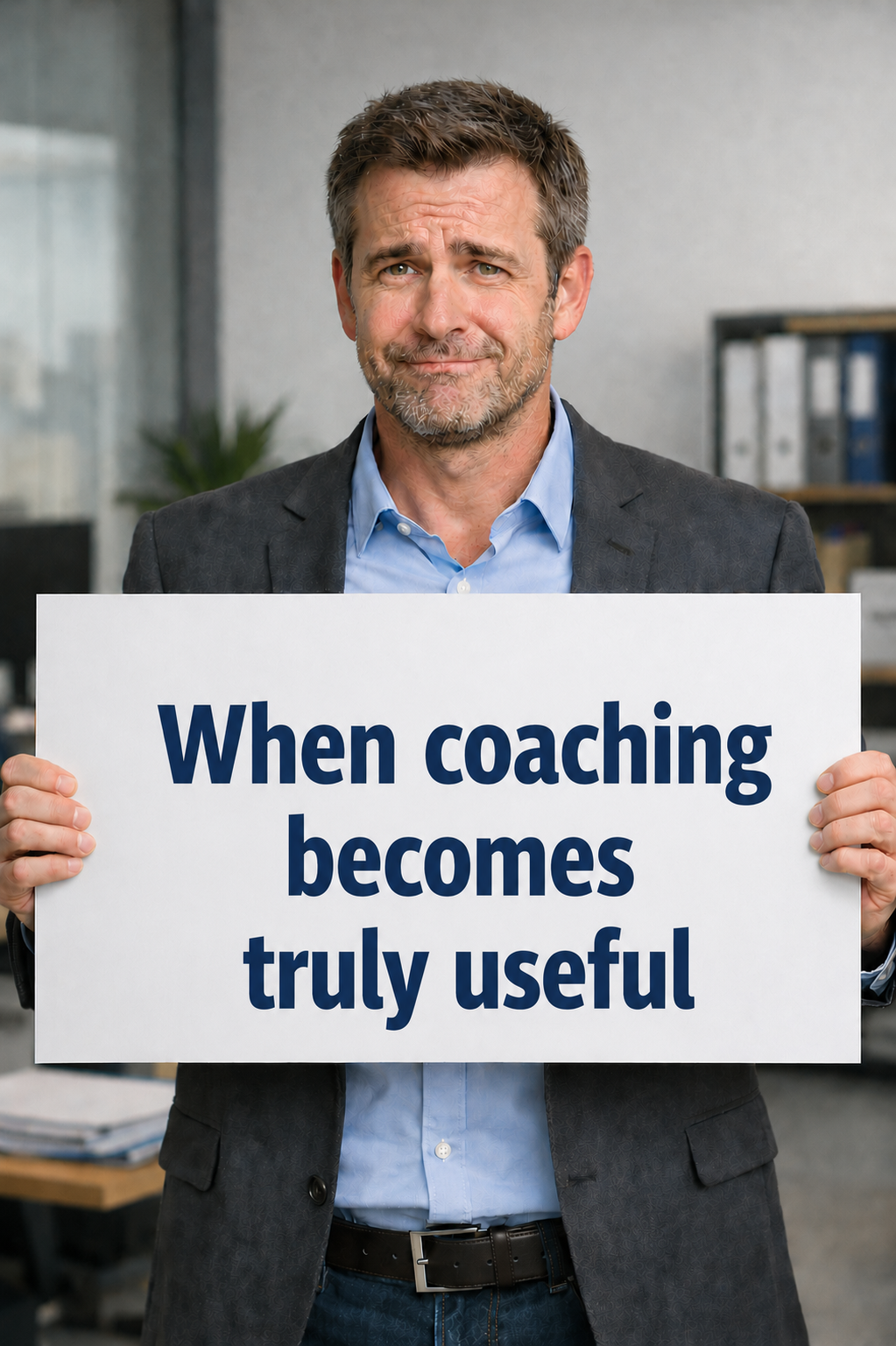
Coaching is not useful when everything is going well. When it is used as an “extra,”a comfort,or a cosmetic performance tool,it produces little effect. Coaching becomes useful when: At that moment, it is no longer about learning.It is about unlearning. Letting go of reflexes that worked for a long time.But no longer do. Coaching is not there to motivate.It is there to shed light. And sometimes, to authorize a change the person had already begun to sense. Personal development coaching can respond to this type of situation.
Month: May 2026
When growth weakens more than it secures

Growth is often presented as an obvious sign of strength: increasing revenue, new opportunities, and expanding teams all seem to confirm the company’s good health. Yet in practice, growth is also one of the first factors of managerial fragility. When activity grows rapidly, the organization often continues to operate according to structures designed for a smaller size and lower complexity. Decision processes, responsibilities, and coordination mechanisms remain those of a simpler structure. For a while, this works. Team engagement compensates for the limitations of the model. Then the first signals appear: progressive overload of the leader, slower decision-making, more frequent trade-offs, and growing dependence on a few key profiles who become the informal pivots of the organization. The fragility does not come from a lack of talent.It comes from the gap between the company’s growth trajectory and the structure of its leadership. At this stage, the question is no longer simply about recruiting “to support growth.”The real question becomes: Is the organization still manageable in its current configuration? The companies that go through these phases most smoothly are those that accept to rethink their leadership structure before growth imposes its own constraints. Because when growth precedes the evolution of management, it can become a source of tension rather than a lever for stability.
Appointment – Partner, Executive Search – Nicolas ANTONINI

Fitch Bennett Partners announces the appointment of Nicolas ANTONINI as Partner within its Executive Search practice. Nicolas began his career in the early 2000s, during the emergence of the digital economy, advising early web and e-commerce players through phases of rapid growth and organizational structuring, particularly in the recruitment of senior executives and the build-out of leadership teams. Throughout his career as a consultant, business unit manager, and later as a leader of executive search firms he has developed recognized expertise across the luxury, software, retail, and digital sectors, as well as in financial services and insurance. He primarily supports organizations undergoing transformation, from startups to scale-ups, in both B2B and B2C environments. An entrepreneur, Nicolas has also founded several ventures in digital consulting, training, and talent management, contributing to the development of innovative approaches to leadership advisory and organizational support. He joins Fitch Bennett Partners to further strengthen the firm’s capabilities in identifying, assessing, and advising senior executives and high-potential leaders, in an environment of accelerating transformation. Originally trained at the École du Louvre and initially oriented towards business law, Nicolas ultimately chose consulting, where he leverages his entrepreneurial mindset and strong understanding of leadership challenges. About Fitch Bennett Partners : Fitch Bennett Partners is an executive search and leadership advisory firm, supporting senior executives in contexts of transformation and growth. The firm adopts a bespoke approach, grounded in a deep understanding of business and governance challenges, and builds close, trusted relationships with its clients, based on a rigorous selection of assignments and a high level of commitment. Fitch Bennett Partners operates in France and internationally, supporting organizations ranging from startups to established groups on high-impact leadership appointments and strategic talent initiatives. Nicolas ANTONINIPartner Mail : nantonini@fitchbennettpartners.comMobile : +33(0)6 26 40 12 93
Why Knowledge Transfer Is the Key to a Successful Mission

A successful interim management mission is not measured only by what has been achieved during the assignment. It is measured by what continues to work after the interim manager has left. In other words, by the organization’s ability to move forward with clear reference points, well-assumed responsibilities, and a stabilized decision framework. From this perspective, knowledge transfer is not merely a final step in the process.It is a responsibility that begins on the first day of the mission. An interim manager does not step in to become indispensable.On the contrary, their value lies in their ability to make the organization progressively autonomous. Without real transfer work, the effects of a mission can quickly fade. Teams fall back into uncertainty, decisions become diluted, and the progress achieved gradually loses coherence. Conversely, when the transfer is prepared from the outset — sharing key information, clarifying processes, supporting teams, and preparing the handover — the organization can sustainably extend the benefits of the mission. This approach requires a specific mindset: that of a leader fully committed to the mission, yet conscious of its temporary nature. A good interim manager always prepares their departure.They organize continuity, secure the handover, and ensure that teams have the reference points needed to continue the work.It is precisely this ability to transfer knowledge that transforms a temporary intervention into lasting impact for the organization.