
A successful interim management mission is not measured only by what has been achieved during the assignment. It is measured by what continues to work after the interim manager has left. In other words, by the organization’s ability to move forward with clear reference points, well-assumed responsibilities, and a stabilized decision framework. From this perspective, knowledge transfer is not merely a final step in the process.It is a responsibility that begins on the first day of the mission. An interim manager does not step in to become indispensable.On the contrary, their value lies in their ability to make the organization progressively autonomous. Without real transfer work, the effects of a mission can quickly fade. Teams fall back into uncertainty, decisions become diluted, and the progress achieved gradually loses coherence. Conversely, when the transfer is prepared from the outset — sharing key information, clarifying processes, supporting teams, and preparing the handover — the organization can sustainably extend the benefits of the mission. This approach requires a specific mindset: that of a leader fully committed to the mission, yet conscious of its temporary nature. A good interim manager always prepares their departure.They organize continuity, secure the handover, and ensure that teams have the reference points needed to continue the work.It is precisely this ability to transfer knowledge that transforms a temporary intervention into lasting impact for the organization.
Fitch Bennett Partners

Why some leadership appointments fail before they even begin
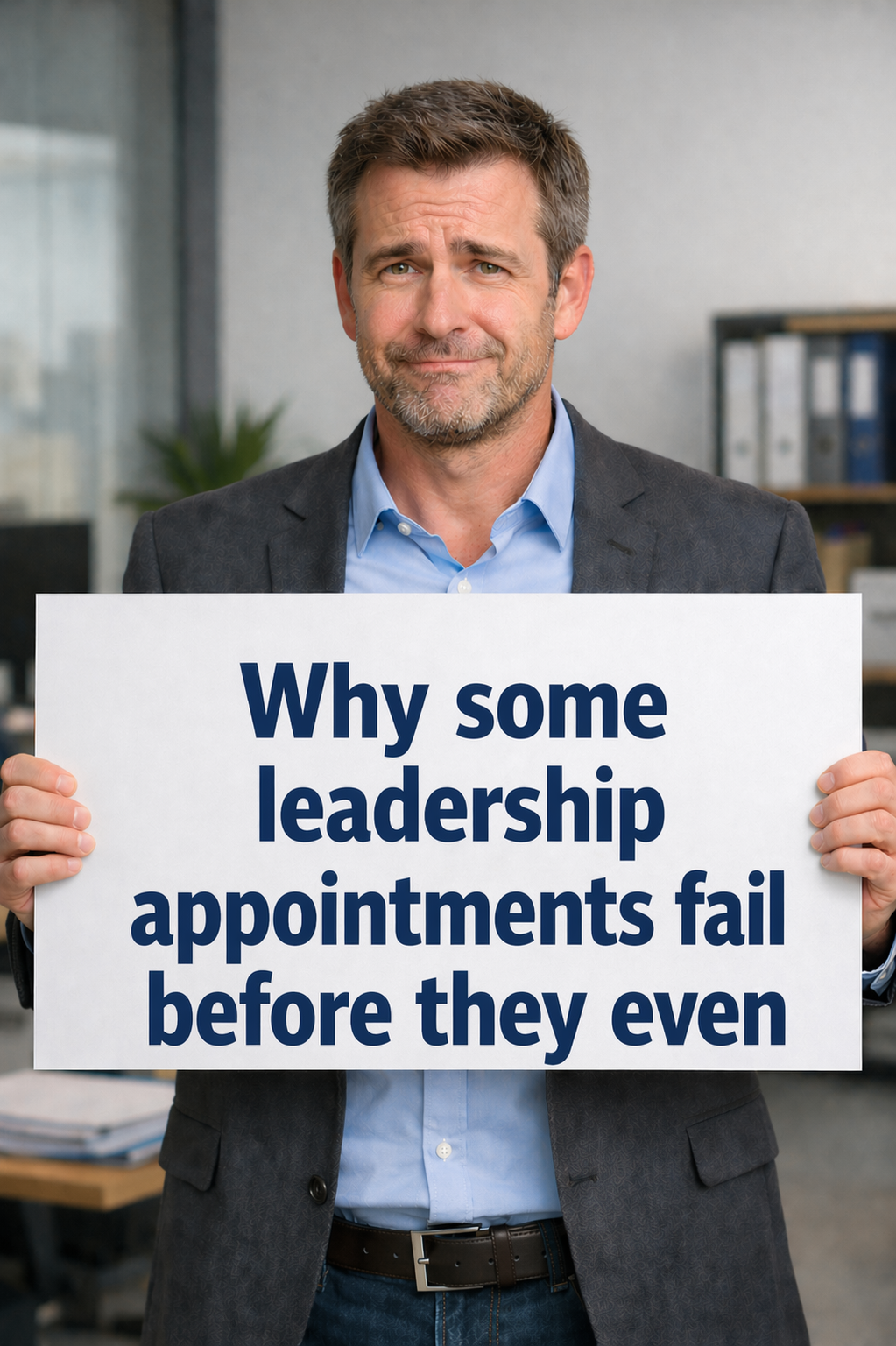
Some leadership appointments fail…before the first day. The contract is signed.The communication is ready.The agenda is full. And yet everything is already there: unspoken issues unrealistic expectations grey areas mutual projections We think the role starts on day one.In reality, it starts much earlier. In what has been said.And especially in what has not. The leaders who succeed are not those who adapt the fastest.They are those who have been able to clarify: what is truly expected of them what will never be officially said what will never depend on them The success of a leadership transition is not simply about execution.It is largely about initial clarity. Onboarding coaching often becomes a key success factor during this critical phase.
The invisible cost of delayed managerial decisions
Postponing a management decision always comes at a cost. It rarely appears in financial statements, but it manifests elsewhere in more subtle ways: increasing executive fatigue, loss of organizational clarity, constant trade-offs, or growing dependence on a few key individuals. This cost is progressive, cumulative, and often underestimated. When a structuring decision is delayed, the organization does not stand still. It adapts. Informal adjustments emerge, responsibilities shift, some employees take on more while others step back. Gradually, a new balance is created — often effective in the short term, but fragile and difficult to challenge. Over time, these informal arrangements become the norm. They blur roles, slow down decision-making, and increase the mental load on leaders. And when the decision eventually becomes unavoidable, the context has already deteriorated. There is no longer enough time to prepare the transition, room for maneuver is reduced, and internal or external pressure intensifies. Conversely, deciding earlier allows organizations to regain control. The decision is no longer a constrained reaction to a tense situation, but a deliberate, prepared, and strategic choice. The real cost is therefore not the decision itself. The real cost is often having avoided it for too long. Fitch Bennett Partners
What an Assessment Really Is
An assessment for a specific role is not meant to reassure.Nor to confirm a decision already made.Nor to “objectify” a political choice. When used this way, it becomes manipulative. A good assessment does not answer:“Is this person good or bad?” It answers:“In this specific context, with these particular challenges,what are the strengths, weaknesses… and the key risk areas to anticipate?” It is not a verdict.It is a tool for clarity. Organizations that use it well are not looking for perfect profiles.They seek to limit risks and provide objective reasons to candidates regarding their selection or non-selection: • an appointment that weakens a team• a role that harms a leader• a decision that cannot be corrected later A useful assessment does not secure a person.It helps benchmark multiple internal and/or external candidates. It secures a decision. Through the combined perspective of its Executive Search consultants and coaches, role plays, and personality assessments, the Fitch Bennett Partners Assessment Center provides an objective and effective solution to support the development of your managers and organizations.
Why Interim Management Is Not a Power Grab

“What if they take up too much space?” This is often one of the first concerns expressed by executives when considering interim management. This concern is understandable. Bringing in an external leader into a key function can create the feeling of introducing a strong presence into an already sensitive balance. In reality, the role of an interim manager is very different from this perception. An interim manager is not there to settle within the organization or to permanently redefine power dynamics. Their primary mission is to hold a critical function at a specific moment, when the company is facing uncertainty, vacancy, or overload. They step in to secure the organization’s operations, ensure continuity in decision-making, and restore clarity for teams. Contrary to common belief, they do not make decisions in place of the CEO or governance bodies. Their role is rather to make decisions possible by restoring clarity in responsibilities, rhythm in execution, and stability in management. In other words, they create the conditions necessary for the organization to regain its capacity to act. In many situations, the real risk is not the intervention of an external perspective. The risk lies in the gradual erosion of internal capacity, when the role is no longer fully carried and no one has the time, energy, or legitimacy to assume it. In such moments, interim management is not a power grab. It is often a way to preserve the organization’s balance. Fitch Bennett Partners
FITCH BENNETT Partners appoints Alexandre Puigvert as Partner to expand its Executive Search practice

Paris – FITCH BENNETT Partners today announced the appointment of Alexandre Puigvert as Partner, strengthening its Executive Search practice focused on senior executive and board-level recruitment. Alexandre Puigvert brings more than 25 years of experience as an international HR executive, advising leadership teams in complex environments, including high-growth and turnaround situations. His background provides a strong operational perspective on governance, leadership, and the critical success factors behind senior hiring decisions. In his role, he will lead executive search assignments, working closely with boards and executive teams on high-impact leadership hires. “Hiring a senior executive is a defining moment for any organization. It’s not just about skills — it’s about aligning vision, culture, and the ability to execute,” said Alexandre Puigvert. “Alexandre’s appointment enhances our ability to deliver on critical leadership mandates, bringing deep operational insight and a strong understanding of executive dynamics,” said the leadership team at FITCH BENNETT Partners. This appointment reflects the firm’s continued investment in its Executive Search capabilities, as organizations place increasing emphasis on leadership quality to drive performance and long-term value creation. About FITCH BENNETT Partners FITCH BENNETT Partners is an international consulting firm specializing in Executive Search, interim management, and career advisory. The firm partners with organizations to recruit senior leaders and identify high-impact talent. Alexandre PUIGVERTPartner Mobile: +33 (0)6 37 92 55 25Mail: apuigvert@fitchbennettpartners.com
Human Risk Is a Strategic Risk

Long considered an operational issue, human risk is now emerging as a major strategic challenge for organizations. The latest HR barometer highlights a profound shift: sustainable performance increasingly depends on the quality of leadership teams, their alignment, and the strength of their people-related decisions. In a context shaped by economic uncertainty, technological transformation, and talent shortages, executive teams can no longer view human capital as a simple adjustment variable. Risks related to leadership, executive succession, retention of key talent, and employee engagement are becoming critical drivers of competitiveness. HR leaders now play a central role in strategic governance. Their responsibilities go far beyond managing human resources: they actively contribute to anticipating transformations, structuring executive teams, and securing critical capabilities. For CEOs and executive committees, the challenge is no longer just about hiring, but about building organizations capable of navigating economic and technological cycles. This requires a clear vision of key talent, rigorous succession planning, and the ability to attract leaders capable of managing complexity. Human risk is therefore not merely operational. It is strategic, as it directly impacts an organization’s ability to make decisions, transform, and create long-term value. In this environment, anticipation and leadership quality become decisive levers of performance. HR Barometer 2026: Discover the key insights. Fitch Bennett Partners
What Leaders Never Say

There is one thing we hear very often from executives.But rarely in public.Rarely in committees.And never in official settings. “I have no one I can really talk to.” They are surrounded.In demand.Apparently listened to.But alone when it comes to sensitive decisions. Not due to a lack of trust in others.But out of lucidity. Because some questions simply cannot be asked:• to their team• to their manager• to their peers• to their relatives• to their shareholders Without consequences. This solitude is not a sign of weakness.It is a structural reality of leadership. The problem begins when this solitude becomes a blind spot.When decisions are made without reflection.Without contradiction.Without a neutral space. The strongest leaders we support are not those who know everything.They are those who rely on a neutral perspective to challenge their thinking. This is where executive coaching can make a real difference. Fitch Bennett Partners
Stabilizing Before Transforming: A Step Too Often Overlooked

In today’s managerial discourse, transformation holds a central place.Digital transformation, organizational transformation, cultural transformation: companies are constantly encouraged to evolve in order to remain competitive. Yet one term is mentioned far less often: stabilization. In many situations we observe, transformation projects do not fail because of a lack of strategic vision. The directions are often clear, the objectives well defined, and the ambitions shared. What is more often missing is the strength of the managerial foundation on which these transformations rely. A key function insufficiently fulfilled.A leader exhausted by operational pressure.A team waiting for clear decisions.Or a project launched without sufficiently structured governance. In such contexts, asking the organization to transform can sometimes mean accelerating on unstable ground. This is precisely when interim management makes sense. Its role is not to transform the company in place of its leaders, nor to impose external change. Its role is first to restore a solid management framework, secure leadership continuity, and provide clarity to teams. In other words, to rebuild a point of balance from which transformation can truly take place. Because stabilizing is not stepping back. It is often the necessary condition to transform quickly — and above all, sustainably. Fitch Bennett Partners
Deciding too early, deciding too late: the real risk lies elsewhere

In the discussions we regularly have with executives, one concern often comes up: the fear of “deciding too early.” Behind this concern lies the idea that a premature decision could lock the organization into a choice that is difficult to reverse. Yet, in the reality of businesses, the most common risk lies elsewhere. Most organizations rarely over-anticipate. They observe, analyze, and wait. Weak signals are identified, tensions are perceived, but the decision is postponed, often out of caution. Gradually, the time for reflection gives way to the time of constraint. And when the decision is finally made, it is no longer truly a choice: it becomes a reaction. The real challenge is therefore not the timing of the decision, but the quality of its preparation. When a leader takes the time to objectify the situation, identify imbalances, clarify responsibilities, and explore several scenarios, the decision remains reversible, adjustable, and controlled. It fits into a strategic logic rather than an emergency-driven one. Conversely, when an organization waits too long, the decision ends up being dictated by circumstances: an unexpected departure, internal tensions, missed opportunities, or market pressure. It then becomes more rigid, more costly, and sometimes imposed rather than chosen. Ultimately, the risk is not deciding too early. The real risk is no longer being able to decide freely. Fitch Bennett Partners